
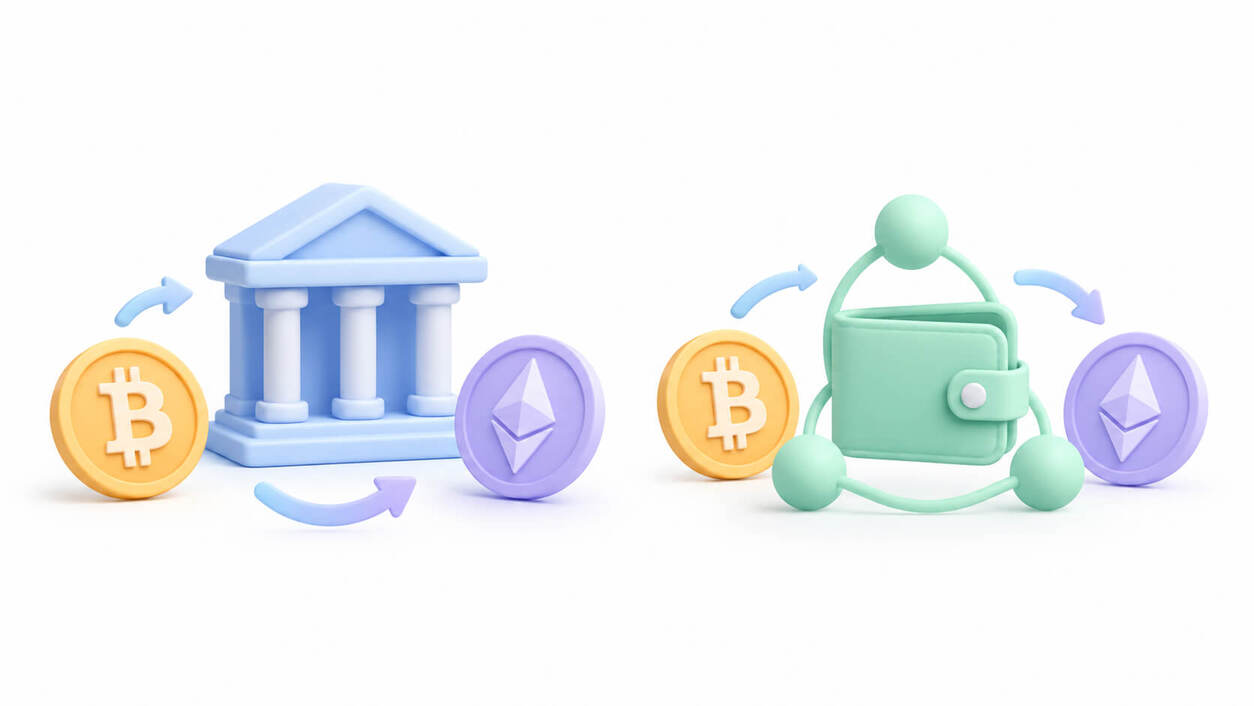
A centralized exchange (CEX) typically holds your crypto in an account and executes trades through its own systems. A decentralized exchange (DEX) lets you trade through blockchain-based software, usually from a wallet you control.
The main difference is custody: who controls the assets and authorizes their movement. That choice also affects fees, account recovery, token availability, and the mistakes you need to avoid.
Coinbase Advanced, Kraken Pro, and Binance.US are centralized trading services. The Uniswap Protocol is a decentralized trading protocol, accessible through apps such as the Uniswap web app and Uniswap Wallet.
This guide compares DEX vs. CEX swaps so you can assess the tradeoffs before choosing a venue.
DEX vs. CEX at a Glance
| Feature | Centralized exchange (CEX) | Decentralized exchange (DEX) |
|---|---|---|
| Asset control | The exchange usually controls deposited assets | You generally control your wallet and authorize transactions |
| How trading works | Usually an exchange-operated order book or quoted conversion | Smart contracts; liquidity pools and order-book designs both exist |
| Getting started | Create an account and typically complete identity verification | Connect or create a compatible wallet and fund it |
| Main costs | Trading fees, spread, and possible deposit or withdrawal charges | Swap fees, network costs, and possible interface or routing fees |
| Asset access | Markets selected by the exchange | Can include permissionless pools, subject to interface restrictions |
| Support | Account support and recovery processes | Support may help troubleshoot, but generally cannot reverse confirmed swaps |
| Main dependencies | Exchange operator, custody arrangements, and withdrawal access | Wallet security, contracts, approvals, and liquidity |
The categories are not absolute. A centralized platform can also offer a separate DEX feature, while a DEX interface can be operated by a company. Check how the specific product handles your assets.
What Is a Centralized Exchange?
A centralized exchange is a company-operated marketplace for buying, selling, and swapping crypto. Users typically deposit assets, place trades, and see their balances updated inside an exchange account.
Many CEXs match orders using an order book, a list of buy and sell offers. They may also offer a simpler conversion feature that presents a quote without requiring you to use a trading screen.
Who Holds Your Crypto on a CEX?
In a standard custodial account, the exchange controls the wallets holding deposited assets. Your account records your balance and withdrawal rights under the platform’s terms.
This can make everyday use more familiar: you have a login, account recovery, and a support team. It also creates dependence on the operator. Withdrawal restrictions, operational failures, or insolvency can affect access to funds.
What Are Maker and Taker Fees?
A maker order adds liquidity to an order book rather than filling immediately. A taker order trades against an existing order and removes liquidity.
An immediately filled limit order can still be a taker order. The order’s execution determines the fee category, not simply whether you clicked “limit” or “market.”
Fee schedules may depend on trading volume, the asset pair, account eligibility, or other criteria. Simple conversion features can use different pricing from the same platform’s advanced trading service.
What Is a Decentralized Exchange?
A decentralized exchange uses blockchain-based software to execute trades. In a typical wallet-based swap, you authorize a transaction that exchanges tokens without first placing them in a centralized exchange account.
Many DEXs use liquidity pools: assets supplied to smart contracts that make trades possible. Other DEX designs use order books or combine different execution methods.
How Self-Custody Works
A self-custody wallet manages the credentials used to authorize transactions. The assets themselves are recorded on the blockchain.
You generally retain control of your wallet, but a swap still interacts with contracts. Token approvals can grant a contract permission to spend particular tokens. Understanding what you approve matters as much as checking the swap quote.
Self-custody also shifts recovery responsibility to you. Depending on the wallet, recovery may involve a seed phrase, passkey, or another mechanism. Losing access to those credentials can mean losing access to the assets.
Who Runs a DEX?
Separate the protocol from the interface. A protocol defines the onchain trading rules; a website or wallet provides a way to interact with them.
Uniswap Labs’ terms distinguish its web interface and wallet from the Uniswap Protocol. Uniswap Labs provides those products, while swaps execute through the protocol’s contracts. Decentralization does not mean every component lacks an operator or governance process.
DEX vs. CEX Fees: Compare the Total Cost
Neither type of exchange is always cheaper. Your final result depends on the trade size, available liquidity, network, and route.
Common CEX Costs
- Trading fees on each executed order.
- A spread or markup in some conversion quotes.
- Payment-method charges when funding an account.
- Crypto withdrawal or cash withdrawal fees.
An internal trade usually does not require a separate blockchain transaction, but moving crypto into or out of the exchange can create additional costs.
Common DEX Costs
- Pool or protocol swap fees.
- Blockchain network costs, often called gas.
- Any interface, routing, or aggregator fees.
- Bridge or cross-chain delivery costs when a route spans networks.
You may also need a token-approval transaction before swapping. Uniswap’s network-cost guide explains that failed onchain transactions can still consume network fees.
Spread, Price Impact, and Slippage
Trading fees are only part of execution cost:
- Spread is the gap between available buying and selling prices.
- Price impact is the effect your own trade has on the execution price relative to available liquidity.
- Slippage is the difference between expected and actual execution prices.
Uniswap’s explanation distinguishes price impact from slippage. Both deserve attention when evaluating a quote.
Compare the same input amount, output asset, and destination. If you intend to hold the result in your own wallet, include CEX withdrawal costs when comparing it with a DEX quote.
Coinbase Advanced, Kraken Pro, Binance.US, and Uniswap Compared
These examples illustrate different trading setups. Availability, supported assets, and account requirements depend on the service and your location.
| Service | Trading setup | Custody | Fee details to review |
|---|---|---|---|
| Coinbase Advanced | Centralized order-book trading | Custodial exchange account | Maker/taker tier, pair-specific rules, and withdrawal costs |
| Kraken Pro | Centralized order-book trading | Custodial exchange account | Maker/taker tier, market-specific schedule, and withdrawal costs |
| Binance.US Advanced Trading | Centralized spot trading | Custodial exchange account | Pair-specific trading fees, funding costs, and withdrawals |
| Uniswap web app or wallet | Interfaces for accessing onchain trading | Self-custody wallet; transactions interact with contracts | Pool and protocol fees, gas, route costs, and any applicable interface fee |
Coinbase Advanced
Coinbase Advanced uses maker/taker pricing. Its guidance says fees depend on the product, tier, and execution, with some pairs subject to separate schedules. Review the order preview and your account’s current rates rather than applying a fee from another Coinbase product.
Kraken Pro
Kraken’s fee schedule sets out trading tiers and separate product categories. The applicable rate depends on the market and eligibility criteria. An older maker/taker range may no longer describe your account’s pricing.
Binance.US
Binance.US publishes its trading fees, including distinctions between pairs and trading tiers. Compare those charges with any funding and withdrawal costs. Confirm service availability for your location before planning a transfer.
Uniswap Web App and Wallet
Uniswap’s web app and wallet provide access to the Uniswap Protocol; they are not two separate custodial exchanges.
At the time of review, Uniswap Labs’ fee page lists no interface fee. That does not make swaps free: pool and protocol charges, network costs, and any additional route costs still matter. Check the final quote rather than assuming all protocol versions or routes use the same fee structure.
Is a DEX Safer Than a CEX?
Neither model removes risk. They place responsibility and dependencies in different places.
CEX Risks
Custodial accounts expose users to exchange security incidents, account takeovers, withdrawal restrictions, and failures affecting the operator. Asset listings and account support do not guarantee that every trade or token is safe.
Proof-of-reserves reports can provide limited information, but they are not equivalent to financial statement audits. The PCAOB’s investor advisory explains that such reports may not fully address liabilities, controls, or future asset availability.
Legal references also need current context. The SEC announced dismissal of its cited Coinbase action in February 2025 and its Binance entities action in May 2025. Those historical cases should not be presented as ongoing proceedings. Their dismissal does not establish that an exchange is risk-free.
DEX Risks
Wallet-based trading exposes users to malicious approvals, fake tokens, compromised interfaces, contract vulnerabilities, and poor execution in illiquid markets. A permissionless pool can exist without a centralized listing review.
Self-custody reduces dependence on an exchange holding your deposits, but it does not protect you from signing a harmful transaction. Once a transaction is confirmed, support generally cannot reverse it.
Which Exchange Fits Your Needs?
Start with your priorities rather than a universal winner.
| Your priority | What to evaluate |
|---|---|
| Familiar account recovery and support | A CEX’s recovery process, support quality, custody terms, and withdrawal access |
| Keeping direct wallet control | A DEX’s contracts, wallet compatibility, approval process, and recovery setup |
| Lower total cost | Comparable quotes including trading, network, funding, and withdrawal costs |
| Access to a specific token | The exact token contract, supported network, liquidity, and listing availability |
| Moving between blockchains | A supported withdrawal network or cross-chain route, including bridge dependencies |
Beginners should also assess how comfortable they are managing transaction approvals and wallet recovery. A simpler screen does not remove the underlying custody or execution risks.
FAQ
What Is the Main Difference Between a DEX and a CEX?
A CEX typically holds deposited assets and operates its trading system. A DEX uses blockchain-based execution, usually accessed from a wallet the user controls. Custody is the main distinction to check.
Is a DEX Cheaper Than a CEX?
Sometimes. DEX gas costs can outweigh a low swap fee, while CEX withdrawal charges can change the comparison. Compare the final amount delivered to the same destination after all relevant costs.
Do You Need a Wallet to Use a DEX?
For a typical self-custody DEX swap, you need a compatible wallet, assets on the correct network, and a way to cover network costs. Some interfaces let you create a wallet within the app.
Do DEXs Require Identity Verification?
Many wallet-based DEX swaps do not require a conventional exchange account. However, interfaces, fiat payment providers, and particular services can impose eligibility checks or geographic restrictions. Check the product’s terms.
Is Uniswap a Centralized Exchange?
The Uniswap Protocol is decentralized trading software. Uniswap Labs develops interfaces, including a web app and wallet, that let users interact with it. Using a company-built interface does not turn a self-custody protocol swap into a custodial exchange account trade.
Can You Lose Crypto on Both a DEX and a CEX?
Yes. On a CEX, losses can involve custody failures or compromised accounts. On a DEX, losses can involve compromised wallet credentials, malicious approvals, contract failures, or poor execution. Market losses can occur on either.