
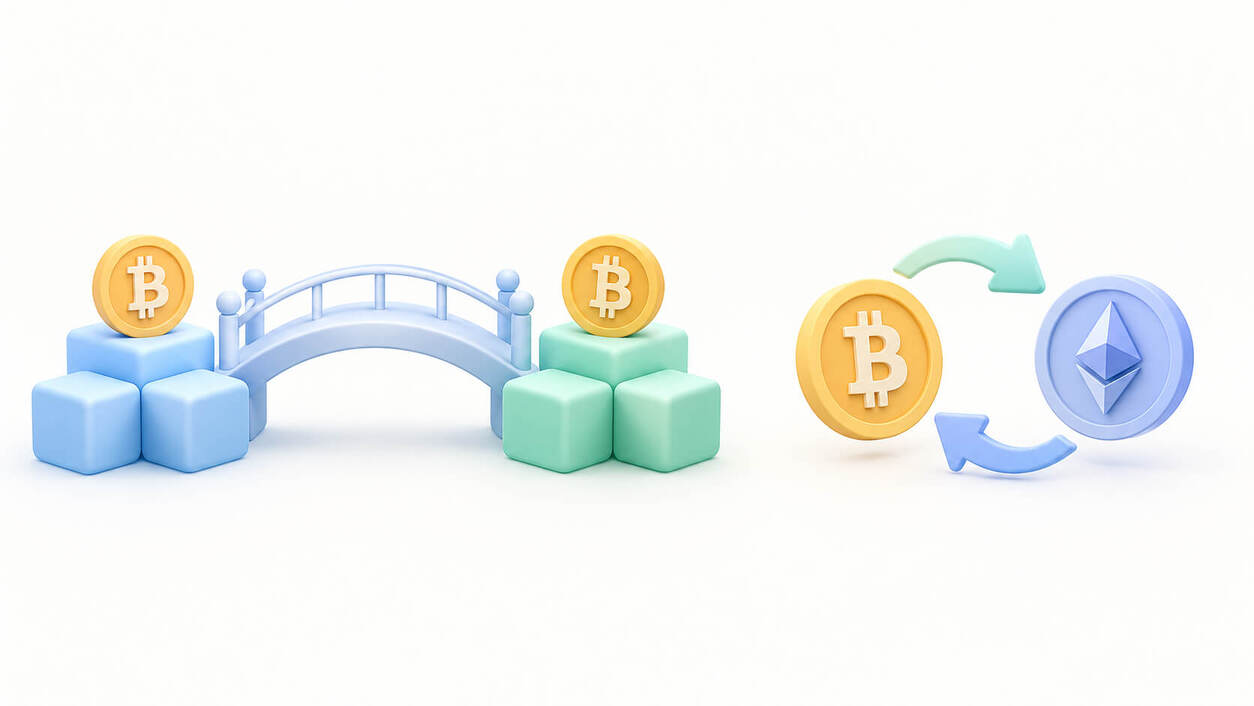
A crypto bridge moves an asset’s value between blockchains, usually preserving exposure to the original asset. A cross-chain swap exchanges one cryptocurrency for another across different blockchains.
For example, moving USDC from Ethereum to another supported network is bridging. Exchanging native Bitcoin (BTC) for native Ether (ETH) is a cross-chain swap.
The distinction matters because it affects the token you receive, the costs you pay, and the risks involved. Some apps combine bridging and swapping in one interface, so understanding the route matters more than the label on the button.
Crypto Bridges vs. Cross-Chain Swaps at a Glance
| Feature | Crypto bridge | Cross-chain swap |
|---|---|---|
| Main purpose | Move value to another blockchain while retaining exposure to an asset | Exchange assets across blockchains |
| Typical result | The same token or a representation of the original asset | A different asset on the destination chain |
| Example | USDC on Ethereum → USDC on another supported chain | Native BTC → native ETH |
| Possible mechanisms | Lock and mint, burn and mint, liquidity pools, or relayer-based transfers | Liquidity pools, protocol vaults, or a combined bridge-and-swap route |
| Costs to check | Network, protocol, relayer, and destination transaction fees | Network and trading fees, spread, price impact, and slippage |
| Risks to assess | Smart contracts, verification, custody, token backing, and settlement | Smart contracts, vaults, liquidity, pricing, and any bridge dependencies |
These categories overlap. A bridge can include trades internally, while a cross-chain swap can depend on a bridge to complete its route.
What Is a Crypto Bridge?
A crypto bridge connects blockchains so users can transfer assets or their representations between networks. The goal is usually to use an asset on a different chain rather than exchange it for a different investment.
Bridges do not all work the same way. Three common approaches are:
Lock and Mint
The bridge locks the original asset on the source chain and issues a wrapped token on the destination chain. That wrapped token represents the asset held elsewhere.
Wormhole’s Wrapped Token Transfers documentation describes this model. The destination token depends on the system that holds the original asset and verifies the transfer.
Burn and Mint
The asset is burned on the source chain and minted on the destination chain through an authorized process.
For USDC, Circle’s Cross-Chain Transfer Protocol (CCTP) uses native burning and minting across supported blockchains. This avoids creating a bridge-wrapped version of USDC for that transfer.
Liquidity-Based Transfers
Users deposit an asset on one chain and receive assets supplied by a pool or relayer on another. The system settles or rebalances those funds according to its own design.
Some routes also exchange tokens along the way. Always check the exact destination token, even when the app calls the transaction a bridge.
What Is a Cross-Chain Swap?
A cross-chain swap exchanges crypto assets across different blockchain networks. Instead of keeping exposure to the original asset, you finish with another cryptocurrency.
For example, a BTC-to-ETH swap starts with Bitcoin on the Bitcoin network and ends with Ether on Ethereum.
THORChain’s native cross-chain swap documentation explains how BTC can be exchanged for ETH through BTC:RUNE and RUNE:ETH liquidity pools. RUNE connects the pools internally; the user does not need to manage that intermediate asset.
A single swap interface does not necessarily mean one blockchain transaction. Depositing funds, confirming the deposit, executing trades, and paying out the destination asset may involve several steps.
Cross-Chain Swaps vs. Same-Chain Swaps
A same-chain swap exchanges assets on one blockchain, such as swapping USDC for another token on Ethereum.
A cross-chain swap involves different networks. That adds settlement steps and dependencies beyond the trade itself.
Why Bridging and Swapping Often Overlap
Many apps combine both actions into one flow. A route might swap your input token, bridge an intermediate asset, and swap again on the destination chain.
Across provides a unified interface for bridging and swapping. Synapse documents routes involving wrapped assets, liquidity pools, and CCTP. Its liquidity-pool routes can use intermediate tokens before delivering the destination asset.
This is why the app’s name alone cannot explain what happens to your funds. Review:
- The input asset and source network.
- The output asset and destination network.
- Any intermediate swaps or wrapped tokens.
- The minimum amount you will receive.
- The refund process if a step cannot complete.
Crypto Bridge and Cross-Chain Swap Examples
The protocols below illustrate different approaches. They are examples of mechanisms, rather than a ranking or a guarantee of availability for a particular route.
| Protocol or transfer system | How it fits the comparison | What to check |
|---|---|---|
| Across | Combines bridging and swapping through a unified routing interface | Output token, route, minimum received, and refund destination |
| Synapse Bridge | Documents wrapping, liquidity-pool, and CCTP routes | Which mechanism the selected route uses |
| Wormhole Wrapped Token Transfers | Uses a lock-and-mint model for wrapped token transfers | Destination token contract and backing mechanism |
| Stargate V2 | Documents same-asset bridging | Supported token route and immediate or batched delivery |
| THORChain | Exchanges supported native assets through RUNE-connected pools | Liquidity, execution conditions, and outbound costs |
| Chainflip | Executes native cross-chain swaps through its protocol | Deposit instructions, confirmation requirements, and payout fees |
Bridge vs. Swap Fees: What Do You Actually Pay?
Neither option is always cheaper. Total cost depends on the networks, amount, liquidity, and steps involved.
A bridge quote may include source-chain gas, protocol or relayer fees, and destination delivery costs. A cross-chain swap may add trading fees and exchange-rate costs. Some interfaces include several charges in the quoted output rather than listing them separately.
Two pricing terms deserve attention:
- Price impact is the change in execution price caused by your own trade relative to available liquidity.
- Slippage is the difference between the expected execution price and the price actually received.
Uniswap’s slippage guidance explains the tradeoff: a very low tolerance can cause a swap to fail, while a high tolerance can allow a worse result.
Compare quotes for the same input amount, output token, and destination network. Look at the final amount received after disclosed costs, alongside the minimum output and refund terms. An advertised fee alone does not capture the full cost.
Crypto Bridge and Cross-Chain Swap Risks
Both methods depend on software and settlement mechanisms that can fail. Ethereum.org’s bridge guide outlines risks including smart contract vulnerabilities, custody assumptions, and failures affecting bridged assets.
Bridge Risks
- Verification failures: A system may accept an invalid message or transfer claim.
- Locked-asset exposure: A wrapped token can lose backing if the assets supporting it are compromised.
- Control and custody risks: Administrators, custodians, or signing groups may have significant authority over funds.
- Delays or pauses: Transfers can be delayed by network conditions or protocol restrictions.
Cross-Chain Swap Risks
- Execution risk: Limited liquidity or changing prices can reduce the output or prevent completion.
- Vault and signing risk: Some protocols rely on shared vaults and groups that authorize payouts.
- Combined dependencies: A bridge-and-swap route inherits risks from each component it uses.
- Refund complexity: An incomplete route may return funds on a different chain or in an intermediate token, depending on its rules.
Native asset delivery avoids receiving a wrapped token, but it does not remove protocol risk. Likewise, an audit does not guarantee that a system cannot fail.
When Does a Bridge or Cross-Chain Swap Fit Your Goal?
A bridge fits a transfer goal: you want to use an asset on another blockchain while retaining exposure to it. Moving native USDC between supported networks is one example.
A cross-chain swap fits an exchange goal: you want a different asset on another blockchain. Converting native BTC into native ETH is one example.
An integrated route can reduce the number of manual steps, but convenience alone does not determine cost or security. Compare the route’s destination token, execution terms, and dependencies.
Before confirming a transfer:
- Verify the official app URL and supported networks.
- Check the destination address and exact token contract, where applicable.
- Confirm whether the output is native or wrapped.
- Review total costs, minimum output, and estimated delivery time.
- Read the refund or recovery instructions before depositing.
- Check whether you will need the destination network’s gas token for later transactions.
FAQ
Is Bridging Crypto the Same as Swapping?
Bridging usually preserves exposure to an asset while moving its value between chains. Swapping exchanges one asset for another. A single route can combine both actions.
Do All Crypto Bridges Use Wrapped Tokens?
No. Some use wrapped tokens, while others use burn-and-mint mechanisms, liquidity pools, or relayer-based transfers. Circle CCTP’s native USDC transfers are one example that does not create bridge-wrapped USDC.
Are Cross-Chain Swaps Safer Than Bridges?
There is no universal safety ranking. Security depends on the contracts, verification process, custody or vault design, and dependencies of the specific route. Some cross-chain swaps use bridges internally.
How Long Does a Cross-Chain Swap Take?
Timing depends on source-chain confirmations, liquidity, execution, and destination delivery. An interface’s estimate may describe delivery to the user rather than final settlement of every underlying step.
Can You Bridge and Swap in One Transaction?
Some apps present both actions as one user flow and may require only one initiating transaction after any necessary approvals. The complete route can still involve multiple transactions across different chains.