
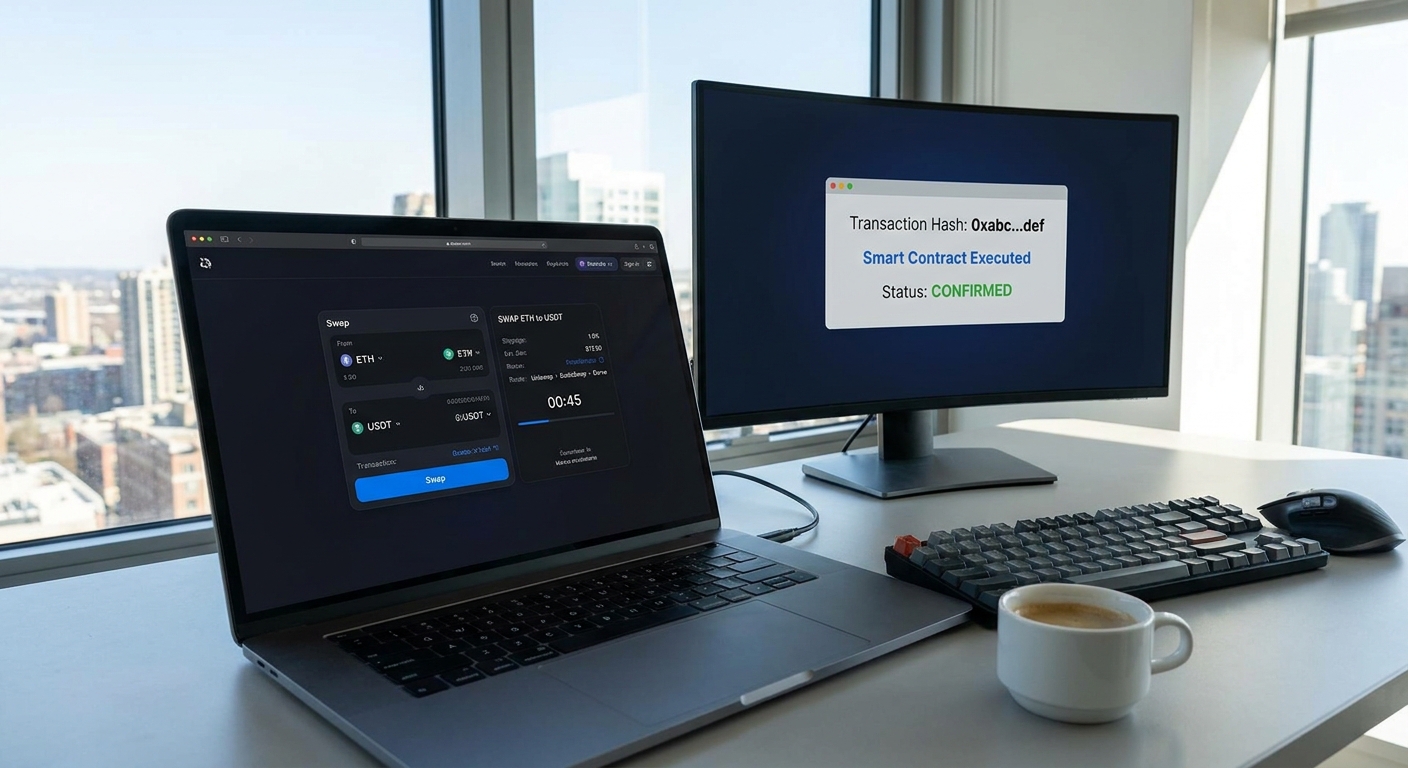
Every time you tap “swap” on a cryptocurrency exchange or decentralized platform, dozens of invisible systems spring into action simultaneously. Your simple click triggers a complex chain of events—price lookups, liquidity searches, smart contract executions, and settlement confirmations—that unfold in milliseconds or minutes depending on the assets and chains involved. Understanding what happens behind the scenes transforms you from a passive user into someone who can read swap quotes like an expert, spot risks before they cost you money, and make informed decisions about which platform and route best serve your trade.
This guide pulls back the curtain on the entire crypto swap lifecycle, from the moment you select your assets to the final confirmation in your wallet. Whether you’re swapping tokens on a single blockchain or moving assets across chains, the mechanics that make it possible operate far below the user interface. By the end, you’ll understand not just what you see on screen, but the infrastructure, algorithms, and risk factors that determine whether your swap executes at the price you expect—or fails entirely.
From Click to Quote: What the User Sees First
When you open a swap interface, the flow feels linear: select a token to send, enter an amount, see a quote, and confirm. In reality, that simple sequence masks a multi-step information-gathering process happening in real time. The moment you input an amount, the platform queries liquidity sources, calculates execution costs, and estimates the exact amount you’ll receive. That quote—which shows your expected output, the exchange rate, and estimated fees—is not permanent. It’s a snapshot valid only for a few seconds, and the platform will warn you if the rate drifts too far before you confirm.
The quote display itself bundles several pieces of information. You see the swap rate (how much of one token you get per unit of the other), the minimum output amount you’re willing to accept (determined by your slippage tolerance), estimated gas or network fees, and sometimes a separate protocol fee charged by the DEX or aggregator. For beginners, this can feel overwhelming. For experienced traders, each number tells a story about market depth, network congestion, and execution quality.
One critical concept: the displayed quote expires. Most platforms show a countdown timer, typically between 20 and 60 seconds. If the blockchain network is congested or prices move sharply, you might see “quote expired” and need to fetch a fresh one. This isn’t a bug—it’s a safety mechanism. By resetting the quote, the platform prevents you from accidentally executing a trade at an outdated price that no longer reflects market conditions.
How a Swap Quote Is Generated
The quote pipeline operates in a specific sequence, and understanding each step clarifies why quotes change and how fees stack up.
- Route discovery: The platform (or aggregator) scans available liquidity sources—decentralized exchanges (DEXs), market makers, liquidity pools, and sometimes centralized exchange (CEX) inventory—to identify possible execution paths for your swap.
- Price and fee estimation: For each viable route, the system calculates the effective price after accounting for slippage on liquidity pools, protocol fees, and network gas costs. It then selects the route (or combination of routes) that delivers the best output amount.
- Quote assembly and expiration: The platform displays the selected route, minimum output amount, and estimated total cost. It assigns an expiration timestamp, usually 20–60 seconds ahead, after which the quote is no longer guaranteed.
- Contingency checks: Before displaying the quote, the system verifies that sufficient liquidity exists, that you have enough balance, and that the trade doesn’t exceed internal risk limits or liquidity constraints.
Why Quotes Change Before You Confirm
Even if you don’t move your mouse, the quote on screen may already be stale. Market movement is the primary culprit: if the price of one of your tokens shifts significantly in that 30-second window, the exchange rate the platform quoted is no longer accurate. On decentralized exchanges powered by liquidity pools, this happens because every swap slightly changes the ratio of tokens in the pool, which shifts the price for the next trade.
Pool depth variations also matter. If other traders execute large swaps before you, the available liquidity shrinks or redistributes, changing the effective price for your trade. On a thin liquidity pool, even moderate trading volume can cause the price to move against you.
Network congestion adds another layer. During periods of high blockchain activity, gas fees spike, which increases the cost of your swap execution. If gas prices were $10 when your quote was generated and jump to $20 by the time you confirm, your total cost climbs without your output amount changing—a form of quote slippage that hits your wallet directly.
Liquidity Sources: Where the Crypto Actually Comes From
Behind every swap is a liquidity source—the pool, vault, or entity that actually holds the tokens you’re receiving. Understanding these sources explains why some swaps cost less than others and why certain pairs trade efficiently while others are expensive or slow.
| Source | How it contributes | Best for | Trade-offs |
|---|---|---|---|
| Automated Market Maker (AMM) | Liquidity pools maintain token pairs; swaps execute against the pool’s reserve ratio using a mathematical formula (e.g., x × y = k). | High-volume pairs on established blockchains (ETH, USDC, DAI); decentralized, non-custodial. | Higher slippage on large trades; price impact increases with trade size relative to pool size. |
| Order Book DEX | Market makers post buy/sell orders; swaps match against these orders instead of pools. | Traders seeking precise control; pairs with sufficient maker participation. | Slower execution if liquidity is sparse; requires active market makers to function. |
| Liquidity Aggregator | Routes your swap across multiple pools and DEXs simultaneously, splitting the order for optimal execution. | Improving price discovery and minimizing slippage; large trades that benefit from fragmented liquidity. | Complexity and higher gas costs for split routing; may execute multiple sub-transactions. |
| CEX Inventory | Centralized exchanges hold internal balances; some swaps route through CEX liquidity via bridge liquidity providers. | Certain pairs unavailable on-chain; fast settlement through centralized systems. | Requires trust in the exchange; not truly decentralized; may involve hidden spreads. |
| Market Makers and Protocols | Professional traders and specialized protocols provide liquidity directly through private pools or OTC contracts. | Large trades where public pools would cause excessive slippage; institutional-grade execution. | Less transparent pricing; may charge higher fees for custom execution; limited access for retail users. |
The distinction between same-chain and cross-chain liquidity is crucial. On a single chain, your swap routes through available pools or market makers on that blockchain. Cross-chain swaps must bridge tokens from one blockchain to another, which introduces additional liquidity considerations and settlement complexity.
The Main Liquidity Models Behind Swaps
| Model | Execution style | Pricing behavior |
|---|---|---|
| Automated Market Maker (AMM) | Deterministic formula (e.g., Uniswap’s constant product); price emerges from the ratio of pool reserves. | Price impact scales with trade size; small trades have minimal slippage, large trades face sharp price moves. |
| Order Book | Matches buyer and seller orders at agreed prices; no price impact until liquidity is exhausted. | Price remains stable until an order is filled; execution can be slower if matching is needed. |
| Aggregator | Splits order across multiple venues to optimize execution path. | Effective price improves by accessing multiple liquidity pools; complexity may offset gas savings on very small trades. |
| Direct LP or Vault | Liquidity provider quotes a custom price, often with a fee markup; less transparent than public pools. | Price can be negotiated or fixed; suitable for large OTC trades; typically higher margins. |
Routing and Price Discovery Behind the Scenes
After the quote is generated, the routing layer determines exactly how your swap will execute. Routing algorithms are the unsung heroes of swap execution quality: they search across liquidity sources, evaluate multiple paths, and often split your order across pools to minimize price impact and fees.
- Multi-venue scanning: The routing engine checks prices and liquidity across all available DEXs, aggregators, and other sources simultaneously. It scores each potential path based on effective price, fee totals, and estimated gas costs.
- Slippage and price impact modeling: The system predicts how the swap will move the price on each pool and adds that cost to the effective price. A path with a lower nominal exchange rate might have higher price impact, while a different route could deliver better output despite appearing less attractive at first glance.
- Gas cost factoring: Routing algorithms weight the cost of executing the swap on-chain. A path that saves gas might be preferred even if the effective exchange rate is slightly worse, because the total cost to your wallet is lower.
- Dynamic fee optimization: The router compares protocol fees across platforms (Uniswap’s 0.3% versus Curve’s 0.04%, for example) and selects routes where fees are justified by better pricing or execution quality.
- Liquidity fragmentation handling: If a single pool doesn’t have enough liquidity to fill your entire order without extreme slippage, the router splits the swap across multiple pools, executing portions at different prices to optimize the blended rate.
How Smart Routing Picks the Best Path
Smart routing isn’t just about lowest price; it’s about lowest total cost and best final outcome. A path showing a 0.5% worse exchange rate might emerge as the winner if it eliminates $5 in gas fees and avoids a 2% price impact hit that would occur on a thin liquidity pool.
The algorithm scores paths using multiple variables: effective price (accounting for slippage), gas cost, protocol fees, execution speed, and reliability. Some routers also factor in historical execution success rates, flagging paths that frequently fail due to slippage or network congestion. The winning route is often a multi-leg swap, especially for less-liquid token pairs. Instead of routing SHIB to ETH directly (which might have poor liquidity), the router finds a path like SHIB → USDC → ETH, where each leg trades on a deeper pool with lower slippage.
When a Swap Is Split Across Multiple Venues
Fragmented liquidity is the norm on decentralized finance, and smart routing exploits this by splitting orders. Here’s how it works:
- Liquidity analysis: The router checks the available liquidity depth at different price tiers across all available pools for your token pair.
- Optimal split calculation: It determines that filling 50% of your order on Pool A and 50% on Pool B produces better overall pricing than executing the entire amount on one pool.
- Multi-transaction assembly: The router creates a single compound transaction that executes both legs atomically—either both succeed or both fail. You see it as one swap, but the contract executes multiple swaps internally.
- Execution and settlement: The smart contract routes funds through the identified venues in sequence, collecting the output tokens and returning them to your wallet as a single amount.
- Gas efficiency optimization: Smart routing engines attempt to batch these splits into as few on-chain transactions as possible, since each transaction carries a gas cost.
Execution Layer: Smart Contracts, Approvals, and Fees
Once you confirm a swap, the interaction shifts from the interface layer to the execution layer—smart contracts, token approvals, and on-chain state changes. This is where the swap becomes real, written to the blockchain and irreversible.
| Step | What happens | User impact |
|---|---|---|
| Token approval (if needed) | You sign a transaction authorizing the DEX contract to spend your tokens. This is a separate transaction with its own gas cost, required only for the first swap with a new token. | First interaction with a token shows two transactions in your wallet: approve, then swap. Subsequent swaps with the same token skip the approval step. |
| Swap contract execution | Your signed swap instruction is broadcast to the blockchain. The contract executes the routing logic, sources liquidity, and swaps your input tokens for output tokens. | Transaction sits in the mempool, waiting for inclusion in a block. Time varies based on gas price and network congestion. |
| State changes recorded | The blockchain updates your token balance, reduces the balance of the liquidity pool, and logs the swap event. | Your balance updates, though it may not immediately reflect in the UI of some platforms; check the blockchain explorer for confirmation. |
| Gas fee deduction | Network validators charge a fee (gas) for computational resources used to execute the transaction. The fee is deducted from your wallet’s native token (ETH, MATIC, SOL, etc.). | Total cost of the swap includes the exchange slippage, protocol fee, and gas fee. High network congestion increases gas costs significantly. |
| Protocol fee (if applicable) | Some DEXs charge a protocol fee on top of liquidity provider fees. This fee is deducted from your output amount. | Your final received amount is lower than the gross output shown before protocol fees. This should be disclosed in the quote. |
| Return to wallet | The swap contract sends the output tokens directly to your wallet address, or to a liquidity aggregator contract that distributes them. | Balance updates in your wallet app, usually within one block confirmation (~15 seconds on Ethereum, faster on other chains). |
The execution layer introduces the first real risk: slippage tolerance. When you confirm a swap, you set a minimum amount you’re willing to receive. If the price moves against you during the time between confirmation and execution—which can be seconds—your swap might fail entirely (revert) if the output would fall below that minimum. This protection prevents bad trades but also means your swap can fail to execute.
Why Some Swaps Need an Approval Transaction
Token approvals are a feature of the ERC-20 standard and similar token protocols across blockchains. Before a DEX contract can transfer your tokens, you must explicitly approve it to do so. Think of it as giving the contract permission to access your vault, but only for a specific amount.
This is separate from the swap itself: the approval transaction sets an allowance (e.g., “this contract can spend up to 1,000 USDC on my behalf”), while the swap transaction performs the actual exchange. The reason for this separation is security—if a contract is compromised, the damage is limited to the approved amount rather than all your tokens.
You only need to approve once per token-contract pair. After that first approval, your subsequent swaps with the same token skip the approval step, saving gas and time. Some advanced users pre-approve unlimited amounts to save future gas costs, but this increases risk if a contract is exploited. Most platforms recommend approving only the amount needed for your current swap.
Cross-Chain Swaps: What Changes When Assets Move Between Chains
Cross-chain swaps introduce an entirely new layer of complexity. Instead of swapping tokens on a single blockchain, your assets must move from one chain to another—a process that requires coordination, message passing, and additional finality checks.
| Step | Same-chain swap | Cross-chain swap |
|---|---|---|
| Quote generation | Check liquidity on the current chain; return quote in seconds. | Check liquidity and bridge pricing across source and destination chains; account for bridge delay and fees. |
| User approval | Single approval transaction (if first interaction with token on that chain). | Approval on source chain; may require additional steps if using a bridge protocol. |
| Execution initiation | Swap contract executes immediately after block inclusion. | Source-chain contract sends tokens to a bridge or liquidity provider; waits for message relay to destination chain. |
| Relay/bridge processing | No additional step; liquidity is on the same chain. | Bridge validators or relayers confirm the transaction on source chain and relay proof to destination chain. Delays: 1 minute to 1+ hours. |
| Settlement on destination | Output tokens appear in your wallet after ~1 block confirmation. | Destination-chain contract receives message, mints or unlocks tokens, and credits your wallet. May require additional confirmation block. |
| Total time | 15 seconds to 5 minutes (depending on chain and congestion). | 5 minutes to several hours (depending on bridge security model and block finality). |
| Failure recovery | Swap reverts automatically if slippage conditions aren’t met; funds return to your wallet. | Failed cross-chain swaps may require manual intervention or waiting for refund; tokens can be locked in bridge escrow temporarily. |
Cross-chain swaps are slower because blockchains can’t directly communicate. Instead, specialized infrastructure—bridges, relay networks, and liquidity providers—act as intermediaries. This introduces latency and additional risk: if the bridge is compromised, tokens can be lost or locked. This is why cross-chain swaps typically charge higher fees and carry higher risk than same-chain swaps.
Bridge, Relay, or Liquidity Provider?
Cross-chain swaps execute through one of three primary methods, each with different risk and speed profiles:
| Method | Mechanism | Risk/benefit |
|---|---|---|
| Liquidity provider (fast swaps) | A liquidity provider holds balances on both chains and exchanges your tokens immediately, then rebalances across chains later. | Fast (seconds to minutes); requires trusting the liquidity provider; subject to tight spreads and fees; doesn’t require bridge message finality. |
| Canonical bridge | Official bridge contracts lock your tokens on the source chain and mint equivalent tokens on the destination chain. Security depends on validator set. | More decentralized than LP swaps; slower (often 1+ hours); higher security due to multiple validator signatures; may involve custodial risk if validator set is small. |
| Third-party relay (e.g., Wormhole, LayerZero) | Relay network observes source-chain event, gathers validator signatures, and posts proof to destination chain. Smart contracts verify and execute. | Moderate speed (10+ minutes typical); security depends on relay network’s validator set; transparent verification on-chain; used by leading aggregators. |
The choice between these methods involves trade-offs. Liquidity provider swaps are fastest but require trust and often cost more. Canonical bridges are slower but offer stronger decentralization guarantees. Relay-based bridges split the difference, offering reasonable speed with distributed security.
Why Cross-Chain Routes Take Longer
The delays in cross-chain swaps stem from blockchain finality requirements and message passing. When you initiate a cross-chain swap, the source blockchain must reach consensus that the transaction is permanent before the bridge or relay network will relay it to the destination. Ethereum takes ~13 minutes for finality; other chains vary.
Even after finality is reached, relayers must observe the event, collect signatures (if required), bundle them, and post them to the destination chain. This process can add 5–60 minutes depending on the bridge security model. Finally, the destination chain must include the relay message in a block and reach its own finality. By the time your swap settles, 10 minutes to several hours may have elapsed—far longer than same-chain swaps, which complete in seconds.
Slippage, Price Impact, and Failed Swaps
Slippage is the gap between the expected price and the actual execution price. On a quiet, deep liquidity pool, slippage is negligible. On a thin pool with your large order, slippage can be severe. Understanding the difference between these mechanisms helps you predict when a swap might fail or cost much more than expected.
- Price impact: The immediate effect of your trade on a liquidity pool’s reserve ratio. Buying into a thin pool raises the price for each subsequent unit you purchase, creating a “U-shaped” cost curve. A $10,000 swap on a deep pool might have 0.1% price impact; on a thin pool, 5% or more.
- Slippage from market movement: Between the time your quote is generated and your transaction executes, the price may move against you due to other traders’ activity or network delays. Setting a slippage tolerance (e.g., 1%) protects you: if the actual output falls below your minimum, the swap fails.
- Volatility and sandwich attacks: On congested networks, your transaction sits in the mempool for seconds or minutes before inclusion. Malicious actors can exploit this by “sandwiching” your trade: buying before you, pushing the price up, and selling after you at a profit—all at your expense.
- Insufficient liquidity: Some pairs have so little liquidity that any swap of meaningful size causes the pool’s reserves to move dangerously out of balance. Beyond a certain threshold, the swap fails because it would create an economically irrational price.
What Makes a Swap Revert or Fill Worse Than Expected
A swap reverts (fails and returns your funds) when the actual output falls below your slippage tolerance, preventing a trade that would significantly harm you. This is a safety feature, but it’s frustrating if you’ve already paid gas to initiate the transaction.
Worse-than-expected fills happen when you ignore slippage warnings or set tolerance too high. A 5% slippage tolerance might sound safe, but on certain pairs or during market volatility, it can mean you accept 5% less value than the quote promised. This loss is real money, paid directly to liquidity providers and market makers who benefited from the price movement.
Front-running and sandwich attacks add malicious slippage: your transaction’s existence in the mempool broadcasts the direction of your trade. Bots can automatically buy the same token before you, pushing the price up, and sell after you execute, capturing the difference. This is why some platforms use private mempools (dark pools) or MEV-protection services to hide your swap from public view until it executes.
Settlement, Confirmation, and What Happens After You Swap
After your swap executes, settlement is the process of finalizing the transaction on the blockchain and making the output tokens usable in your wallet. This is distinct from execution: a transaction can execute and then later fail during settlement if conditions aren’t met.
On Ethereum and most chains, settlement requires confirmations—additional blocks added after your transaction’s block. One confirmation means your block has been mined and one new block has been added after it, making it highly unlikely that your transaction will be reversed. Most platforms consider a swap settled after 12+ confirmations, though wallets show balances after just one.
For cross-chain swaps, settlement is more complex. Your destination-chain balance updates only after the bridge or relay confirms the source-chain transaction. Until that happens, the funds are in limbo—locked on the source chain or held by the bridge.
How You Know the Swap Is Finished
The status of your swap progresses through several states, and understanding each helps you know when it’s safe to use your new tokens:
- Pending: You’ve signed the transaction and it’s broadcast to the network, waiting in the mempool for inclusion in a block. Status shows “pending” or “submitted.”
- Confirmed: The transaction has been included in a block and is permanent (one or more blocks have been added after it). Status changes to “confirmed,” though wallets may still mark it as “pending” until finality is reached.
- Completed: On centralized platforms, this means the transaction is fully settled and funds are available. On decentralized systems, this typically occurs after 12+ confirmations. Your balance updates in the app.
- Failed: The transaction was broadcast but reverted on-chain, usually because slippage tolerance was exceeded, there was insufficient liquidity, or a contract error occurred. Your input tokens are returned to your wallet; gas fees are lost.
For cross-chain swaps, add extra states: “awaiting relay confirmation” (message being validated by relay network), “relayed” (message confirmed on destination chain), and “settled” (output tokens received on destination chain).
How to Read a Swap Like an Expert
Expert swap traders don’t just look at the headline exchange rate—they decode the entire quote to understand hidden costs, execution quality, and risk. By learning to read these signals, you can compare swaps across DEXs and aggregators and spot red flags before confirming.
| Signal | What it tells you | Why it matters |
|---|---|---|
| Effective price vs. nominal rate | If the displayed exchange rate is 1 USDC = 1,200 SHIB but your effective output is only 1,180 SHIB, the 20 SHIB difference is slippage and fees combined. | Effective price reveals the real cost of your swap, accounting for hidden price impact and fees that aren’t broken out separately. |
| Minimum received amount | The guaranteed output if you accept the current slippage tolerance. Falls if you increase tolerance; rises if you lower it. | This is your protection: if the actual output falls below this, the swap fails. Too high a tolerance exposes you to bad fills; too low and the swap may never execute. |
| Price impact percentage | Shows the percentage cost of moving the price on the liquidity pool. 0.5% is excellent; 5%+ is concerning. | High price impact signals thin liquidity or an outsized trade relative to pool size. Consider breaking the swap into smaller orders or using a different pool/DEX. |
| Routing path | DEX aggregators display which pools or venues will execute portions of your swap. Multi-venue routes are common on large trades. | A complex route with many hops may incur higher gas costs that offset better pricing. Simple, one-pool routes are faster and cheaper on small amounts; splits are better for large amounts. |
| Fee structure breakdown | Some platforms itemize liquidity provider fees, protocol fees, and gas costs separately. | Transparency here is rare but valuable: you can see exactly where money goes and compare total cost across platforms. Uniswap’s 0.3% LP fee vs. Curve’s 0.04% makes sense for stable pairs but not volatile ones. |
| Quote expiration timer | Countdown showing how long this quote is valid. Usually 20–60 seconds. | A short timer (20 seconds) is tight if network is congested; you may miss it. Longer timers (60+ seconds) offer more buffer but may become stale if prices move sharply. |
| Gas price and slippage settings | Advanced interfaces show estimated gas cost and your selected slippage tolerance (often 0.5–3%). | High gas prices make small swaps uneconomical; low slippage tolerance protects you but risks failed execution. Balance them based on your trade size and market volatility. |
Practical Checks Before You Confirm
Before you click confirm, run through this checklist to avoid costly mistakes:
- Token address verification: Confirm you’re swapping the correct token, not a scam token with a similar name. Check the contract address on the blockchain explorer against official sources.
- Network selection: Verify you’re swapping on the intended blockchain. Sending tokens to the wrong network means they’re lost in that network’s contract ecosystem.
- Slippage tolerance assessment: For stable pairs, 0.5% is plenty. For volatile tokens, 1–3% is reasonable. Above 3% is risky unless the pair is extremely volatile. Check recent price movement.
- Fee comparison: If available, compare total costs (price impact + gas + protocol fee) across at least two platforms. Aggregators often win, but DEXs with higher volume on your specific pair may be cheaper.
- Liquidity depth check: On the quoted pool, check if your trade size is a small fraction of daily volume. If your swap is 10%+ of the pool’s reserves, expect high slippage and consider splitting.
- Cross-chain route review: For cross-chain swaps, identify the bridge method (LP swap, relay, or canonical bridge). LP swaps are fast but costlier; relays are slower but cheaper. Choose based on your priorities.
- Gas price context: Check the network’s current gas price. If it’s 2–3× above the average, consider waiting unless your swap is urgent. On lower-priority chains, gas is typically negligible.
The Most Important Risk Signals to Watch
Certain warning signs should stop you before you confirm:
Scam tokens are the most dangerous. A token with extremely high price impact or a quote that seems too good to be true (e.g., swapping $100 for $10,000 worth of a token) is a major red flag. Always verify the token contract address and check its holder distribution on blockchain explorers.
Wrong network selection is costly. Confirm the network matches your actual token location. A common mistake: trying to swap USDC on Polygon but having only Ethereum USDC in your wallet.
Unusually high price impact—above 10% on a legitimate pair—suggests something is wrong. The liquidity pool may be compromised, the pair may be newly created, or you may have selected the wrong token. Investigate before proceeding.
Failed quote generation means the platform couldn’t find sufficient liquidity for your swap. Don’t ignore this: forcing the swap through may result in extreme slippage or a failed transaction.
MEV warnings from platforms like MEV-resistant DEXs alert you that your trade may be susceptible to front-running. If the warning appears, consider waiting for lower congestion or using a MEV-protection service.
Understanding these behind-the-scenes mechanics transforms your swap from a black box into a transparent, predictable process. Each signal you learn to read reduces your risk and improves your execution quality. Whether you’re a casual trader or a frequent swapper, the combination of knowledge about routing, liquidity, approvals, and settlement ensures you’ll make informed decisions and avoid expensive mistakes. The next time you see a quote, you’ll know exactly what’s happening beneath the surface and why that particular route, fee, and slippage profile makes sense for your trade.