
When you swap tokens on a decentralized exchange (DEX), the price you see quoted is rarely the price you actually pay. This gap between expectation and reality—called slippage—occurs because DEXs don’t use traditional order books. Instead, they rely on liquidity pools: reserves of token pairs locked in smart contracts that automatically price trades based on mathematical formulas. Understanding how these pools work, how they determine prices, and why slippage emerges is essential for anyone trading on decentralized platforms. The relationship between pool depth, the automated market maker (AMM) algorithm, and slippage determines not only your final execution price but also whether a swap should happen at all.
This article explains the mechanics behind decentralized swaps from the ground up. You’ll learn why liquidity pools power modern DEXs, how AMMs calculate prices in real time, what slippage actually is and where it comes from, and most importantly, how to evaluate pools and control your execution costs before you trade. Unlike many explainers that stop at definitions, this guide connects theory to trader decision-making: when slippage is acceptable, when to split orders, and how to read pool metrics like a professional before pressing the swap button.
What liquidity pools are and why DEXs use them
A liquidity pool is a smart contract holding two or more tokens in fixed reserves. When you swap token A for token B, you don’t trade with another person—you exchange your tokens directly with the pool. The smart contract adjusts the reserve balances and calculates your output price based on the new ratio. This model eliminates the need for a counterparty and allows trading to happen instantly on-chain, 24/7, without waiting for a matching order.
This approach differs fundamentally from traditional order books, which match buyers and sellers at negotiated prices. On centralized exchanges, liquidity comes from traders placing limit orders. On decentralized platforms using AMMs, liquidity comes from passive providers who deposit equal values of two tokens and earn a portion of trading fees in return. The tradeoff is that pooled liquidity creates price slippage—especially for large trades—because each swap shifts the pool’s reserve ratio and moves the price along a curve.
Liquidity pools in simple terms
A liquidity pool begins when someone deposits two tokens—for example, 100 ETH and 300,000 USDC—into a smart contract. That deposit creates a liquidity provider (LP) position tracked by LP tokens, which represent a pro-rata share of the pool’s fees and reserves. When a trader swaps 10 ETH for USDC, the contract adds 10 ETH to the pool and removes USDC from it. The smart contract then calculates the output based on the updated reserve ratio, ensuring the pool’s mathematical invariant (its core pricing rule) remains intact.
This permissionless design means anyone can create a pool, anyone can provide liquidity, and anyone can trade without permission or intermediaries. Because pools are on-chain, all trades settle within a single blockchain transaction, and pool reserves are transparent and auditable by any observer. The simplicity and transparency of this model are why AMM-based pools have become the dominant trading infrastructure in decentralized finance.
Why AMM-based swaps replaced order books in many DeFi markets
Automated market makers offer continuous pricing and instant execution, two properties that traditional order books struggle to provide at scale in decentralized environments. On a DEX with an order book, traders would need to post limit orders and wait for matches—a process that works well for centralized platforms but introduces friction and latency on-chain. With AMMs, liquidity is always available at a mathematically determined price, and swaps execute in a single transaction.
Pool-based pricing also enables efficient capital allocation. Instead of fragmenting liquidity across thousands of limit orders, AMMs concentrate all reserves in a single reserve ratio. This creates a clear, transparent price that updates instantly with each trade. For tokens without deep institutional trading infrastructure, AMM liquidity often exceeds what traditional order books could support, making DEXs the natural home for emerging and alternative tokens.
How AMMs set prices from pool reserves
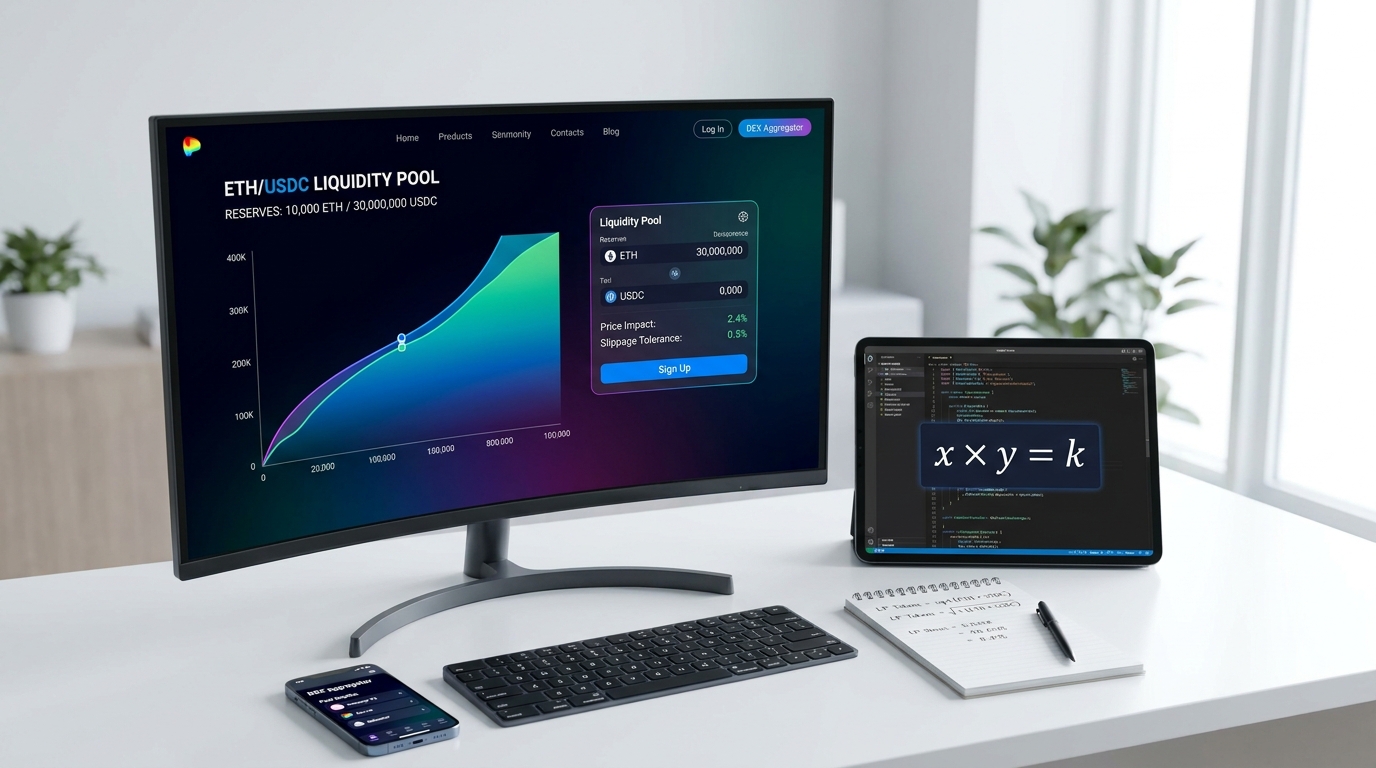
AMM prices are not set by supply and demand in the traditional sense. Instead, they emerge from a mathematical formula that relates the two token reserves. The most common formula, used by Uniswap and many other leading DEXs, is the constant product formula: x × y = k, where x and y are the token reserves and k is a constant. When you execute a swap, the formula adjusts the reserves so that their product remains constant (or stays within a small tolerance if fees apply).
Here’s how a trade flows through this pricing mechanism:
- You specify an input amount. You decide to swap 1 ETH for USDC at the current pool ratio.
- The contract calculates the output. Using the constant product formula, the smart contract determines how much USDC you receive by computing the change in reserves that keeps x × y = k constant.
- The reserve ratio shifts. As ETH is added and USDC is removed, the pool becomes relatively more abundant in ETH and scarcer in USDC.
- The pool price moves along the curve. Because the reserve ratio changed, the price of ETH (in USDC) is now higher than it was before your trade. This price movement is the price impact—the direct cost of your trade size relative to the pool.
- Your execution price differs from the initial quote. By the time your transaction settles, other trades may have occurred, or mempool delays may have shifted the pool again. The difference between what you were quoted and what you actually received is slippage.
The constant product formula and reserve ratio
The constant product formula works like a seesaw: as you add more of one token, you must remove proportionally more of the other to keep the product constant. If a pool holds 1,000 ETH and 3,000,000 USDC (k = 3 billion), and you swap 1 ETH for USDC, the pool must expand ETH to 1,001 and reduce USDC. To keep the product at 3 billion, the new USDC amount is 3,000,000 ÷ 1.001 ≈ 2,997,001. You receive about 2,999 USDC.
This formula creates a bonding curve: the more ETH you swap, the fewer USDC you receive per ETH, because the pool becomes increasingly imbalanced. A 10 ETH swap receives far fewer USDC per ETH than a 1 ETH swap from the same pool. This is price impact, and it’s a built-in consequence of the constant product formula. Larger trades and thinner pools produce steeper curves and higher price impact, which directly translates to worse execution prices.
What slippage means in decentralized swaps
Slippage is the difference between the price you expected to receive and the actual price you received when the trade executed. If you are quoted 2,000 USDC per ETH and receive only 1,950 USDC per ETH, you’ve experienced 50 USDC of slippage. This definition is broad enough to include multiple sources of slippage: price impact from your trade size, price movement while your transaction was pending, and extraction by miners or bots (MEV).
Most traders and interfaces conflate all of these under the term “slippage,” but separating them clarifies where execution costs come from and which you can actually control. Price impact is unavoidable if you’re trading a large order in a small pool—it’s the mathematical cost of the swap itself. Market movement and MEV are external factors that can worsen your execution even if price impact is small.
Slippage versus price impact
Price impact is the change in the pool’s price caused by your trade. It’s calculated before you submit the transaction and is a direct function of your swap size relative to the pool’s reserves. If the pool holds 10,000 ETH and 30,000,000 USDC, a 100 ETH swap has significant price impact; a 1 ETH swap has negligible price impact. Price impact is deterministic and unavoidable—it’s the cost of trading against a fixed mathematical curve.
Slippage, more broadly, includes price impact plus any price deterioration between the time you quote the trade and the time it settles. If the pool’s price moves against you while your transaction is in the mempool, or if a sandwich bot executes trades before and after yours, your final execution price worsens beyond the price impact you calculated. This distinction matters because it tells you whether poor execution is due to your trade size (addressable by splitting) or external factors (addressable by higher slippage tolerance or better routing).
Why low liquidity and large orders increase slippage
Thin pools create steep bonding curves. If a pool holds only 100 ETH and 300,000 USDC, a 10 ETH swap consumes 10% of the ETH reserves and produces severe price movement. The ratio shifts dramatically, and you receive far fewer USDC per ETH than the pool’s initial price would suggest. Conversely, a pool with 100,000 ETH and 300,000,000 USDC can absorb the same 10 ETH swap with minimal price movement because it represents only 0.01% of reserves.
Trade size relative to pool depth is the primary driver of price impact slippage. When you execute a swap that is a large percentage of the pool’s reserves—say, more than 5%—you should expect significant slippage. Splitting such orders across smaller transactions, different pools, or different times can reduce the average price impact, though it increases the number of transactions and gas costs. This tradeoff is a key decision point for larger traders.
Key factors that make slippage worse
Beyond pool depth and trade size, several operational factors consistently worsen slippage in real-world decentralized swaps:
- Thin liquidity in your token pair. Obscure or newly launched tokens often have minimal pool depth. Even small swaps can move prices dramatically. Check whether alternative pools exist for the same pair; sometimes a different fee tier or pool address offers better depth.
- High volatility during the swap window. Volatile markets produce wider bid-ask spreads on pools as LPs increase their fees or as the reserve ratio shifts rapidly. Swapping during periods of sharp price movement amplifies slippage.
- Large trade size relative to pool reserves. A 10% trade in a pool moves the reserve ratio much further than a 0.1% trade. For large orders, splitting across multiple swaps or using routing algorithms that split across multiple pools can reduce average slippage.
- Confirmation delays in the mempool. If your transaction sits pending while other trades execute, the pool’s price may move against you before your swap settles. Network congestion and high gas prices increase delay risk.
- MEV and sandwich attacks. Sophisticated bots can front-run your transaction by buying the token you want to swap, pushing its price up, and then allowing your trade to execute at a worse price. They then sell their tokens after your transaction, profiting from the spread. This MEV cost is hidden from most traders but real.
- Pool fees that reduce output. Most pools deduct a small fee (typically 0.01% to 1%) from your output. These fees are paid to liquidity providers but reduce your net received amount.
- Unaudited or low-quality smart contracts. Some newer pools use non-standard formulas or have smart contract bugs that can cause trades to fail or execute at unexpected prices.
Main slippage drivers in AMM trades
The most consequential slippage drivers are pool depth and trade size, followed by market timing and MEV. You directly control your trade size and can choose when to execute. Pool depth is fixed at the moment of your trade but can be improved by selecting a deeper pool or a more liquid trading pair. MEV and delays are harder to control but can be mitigated by choosing platforms that use MEV protection, private mempools, or intent-based routing.
Understanding these drivers helps you decide whether a swap is worth executing at all. If the slippage on your desired trade exceeds your tolerance, consider splitting the order, waiting for better market conditions, or using an alternative pair or pool.
How liquidity providers earn fees and take on risk
Liquidity providers deposit token pairs into pools and earn a share of all trading fees that occur in those pools. If a pool charges 0.3% per trade and generates $1 million in daily volume, it distributes $3,000 in fees pro-rata among all LPs based on their share of the pool’s total liquidity. This fee income can be attractive, especially in high-volume pairs, but LPs face unique risks that traders do not.
| LP benefit or risk | What it means | Practical implication |
|---|---|---|
| Fee income | LPs earn a percentage of every swap in their pool | Annual returns can exceed 100% in volatile, high-volume pools, but are often 5–20% in stable pairs |
| Impermanent loss | If token prices diverge significantly, LPs’ position value can drop below the value of simply holding the tokens | A 50% price divergence can cause 25% impermanent loss; volatile pairs are riskier |
| Smart contract risk | Bugs or exploits in the pool’s smart contract can cause total loss of deposited funds | Always use audited, battle-tested pools and avoid newly launched or experimental DEX protocols |
| Slippage paid by traders | As traders experience slippage, LPs benefit indirectly by earning the fee portion of that slippage | High slippage environments produce higher fee income but attract fewer traders and less volume |
| Exposure to both tokens | LPs are always long both tokens in the pair, regardless of market direction | If one token drops in value while the other rises, LPs lose value even if their pool fee income is positive |
| Concentrated liquidity risk | On DEXs with concentrated liquidity, LP positions become inactive if prices move outside a chosen range | LPs must actively manage their positions or risk earning no fees on capital that’s no longer providing liquidity |
Fee earnings and pool shares
When you deposit tokens into a pool, you receive LP tokens that represent your ownership share. If you deposit 1 ETH and 3,000 USDC and the pool holds 1,000 ETH and 3,000,000 USDC, you own 0.1% of the pool. Every swap in the pool generates a fee—typically 0.01%, 0.05%, 0.30%, or 1.00% depending on the pair’s risk level and the pool’s design. Your 0.1% share entitles you to 0.1% of all fees that pool generates.
Fee distribution is automatic and ongoing. When you withdraw your liquidity, you burn your LP tokens and receive your original token ratio (adjusted for fees earned) back from the pool. The longer you provide liquidity and the more trading volume the pool attracts, the more fees you accumulate. This model aligns LP incentives with pool depth: LPs are rewarded for providing liquidity exactly when and where traders need it most.
Impermanent loss and other LP risks
Impermanent loss occurs when the prices of the two tokens in a pool diverge. If you provide liquidity to an ETH/USDC pool when ETH is $2,000 and later ETH rises to $3,000, the pool’s constant product formula forces it to hold more ETH and less USDC than it did initially. You’re forced to sell ETH at lower prices as traders swap USDC for it. If you had simply held your original ETH and USDC without providing them to the pool, you’d be worth more than your LP position is worth—the difference is impermanent loss.
The loss is “impermanent” because it can recover if prices return to their original ratio, but in volatile markets, prices rarely do. A 2x price divergence (where one token doubles relative to the other) produces about 5.7% impermanent loss; a 3x divergence produces 13.4%. In extremely volatile pairs, impermanent loss can exceed fee earnings, causing LPs to lose money overall. This risk is why high-volume, stable pairs (like ETH/USDC) attract more LP capital than volatile emerging token pairs, even though emerging tokens often offer higher fee percentages.
How traders reduce slippage in decentralized swaps
If your quoted slippage exceeds your comfort level, you have several practical tools to improve execution before you submit your transaction:
- Select a deeper pool for the same trading pair. Most major token pairs trade across multiple pools with different fee tiers or on different DEXs. Compare the reserve depth, fee percentage, and recent volume of each option. A 0.05% fee pool with 10x the liquidity usually produces better execution than a 0.01% fee pool with thin reserves, even though the 0.01% pool’s fee appears cheaper.
- Split large orders into smaller swaps. Instead of swapping 100 ETH in one transaction, swap 10 ETH five times across an hour or day. Each smaller trade experiences less price impact, and the average execution can be significantly better. This strategy costs more gas but is worthwhile for trades that are more than 2–3% of the pool’s reserves.
- Swap toward stablecoins or established tokens first. If you’re selling an obscure token, the direct pool may have minimal liquidity. Try swapping to a more liquid token (like ETH or USDC) first, then swapping that to your final target token. Multi-hop routing often produces better prices than direct pools, especially for emerging tokens.
- Increase your slippage tolerance gradually and monitor execution. Set a tight slippage limit (like 0.5%) for small trades; if the swap fails, you know the pool is too volatile or too thin for that size. For larger trades, increase tolerance (to 1–3%) after confirming the pool’s depth is adequate. Most DEX frontends allow you to adjust this before confirming.
- Time your swap for lower volatility. Slippage widens during market spikes and flash crashes. If you can wait for calmer market conditions, prices stabilize and pool reserves move more predictably. This is especially true for smaller pools backing volatile tokens.
- Use intent-based routing or aggregator protocols. Advanced DEX platforms and aggregators split your order across multiple pools and routes automatically, calculating the path that minimizes slippage. These tools add convenience and often deliver better execution than picking a single pool manually.
Practical methods to limit slippage
The most effective approach combines multiple strategies based on trade size and pool characteristics. For trades under 0.5% of a pool’s reserves, accept the slippage and execute immediately; it’s usually minimal. For trades between 0.5% and 2%, compare alternative pools and fee tiers before deciding. For trades over 2%, split the order or use a routing aggregator.
Understanding your pool’s depth and your trade size relative to it transforms slippage from an opaque surprise into a predictable cost. Before every swap, ask: Is this pool deep enough for this trade size? If the answer is no, change your approach instead of accepting poor execution.
How to evaluate a pool before swapping
A structured pre-swap checklist helps you identify pools likely to give you good execution and avoid pools that will cost you money through slippage, fees, or risk. Use the following metrics to compare pools for the same trading pair:
| Pool metric | What to check | Why it matters |
|---|---|---|
| Total liquidity (TVL) | Look at the total dollar value of reserves. Pools with $10M+ TVL usually have enough depth for trades under 1% of reserves. | Deeper pools absorb larger trades with less price movement. A $100k pool and a $100M pool will produce drastically different slippage for a $50k trade. |
| Reserve balance for your trade size | Calculate your swap as a percentage of the pool’s reserves. Aim for under 1% if possible; avoid over 5%. | This percentage directly correlates with price impact slippage. A 5% trade in a balanced pool sees 5%+ slippage; a 0.5% trade sees ~0.5% impact. |
| Fee tier | Check the pool’s fee percentage (0.01%, 0.05%, 0.30%, 1.00%). Compare against pool depth. | Higher fees directly reduce your output but may reflect the pool’s risk level. A 1% fee pool with thin liquidity is usually worse than a 0.30% pool with deep reserves. |
| 24-hour trading volume | High volume suggests active trading, deeper effective liquidity, and tighter bid-ask spreads. | Pools with $1M+ daily volume usually have good depth. Pools with < $10k daily volume are likely to be thin and volatile. |
| Recent price stability | Check the pool’s price history. Wide swings suggest volatility that will worsen slippage. | If the pool’s price moved 10%+ in the last hour, slippage will be high on any trade. Wait for calmer conditions if possible. |
| Smart contract audit status | Verify the pool’s smart contract is from a known, audited DEX or protocol (Uniswap, Curve, Balancer, etc.). Avoid unaudited pools. | Contract bugs or exploits can cause total loss. Always prioritize audited, battle-tested protocols over potentially higher-fee experimental DEXs. |
| LP concentration | Check whether a small number of LPs control a large percentage of the pool. High concentration is a red flag. | Concentrated LPs can withdraw liquidity suddenly, thinning the pool and spiking slippage. Diverse LP bases are more stable. |
Pool depth, volume, and fee tier
The interplay between these three metrics determines execution quality. A pool with $50M depth, $10M daily volume, and a 0.05% fee tier is usually excellent for any trade under $500k. A pool with $500k depth, $20k daily volume, and a 1% fee tier is thin and risky even for $5k trades. The fee percentage alone tells you nothing useful without considering depth and volume.
When comparing pools, prioritize depth and volume over fee percentage. A 0.30% fee in a deep pool beats a 0.01% fee in a thin pool because the deep pool’s lower slippage more than compensates for the higher fee. This logic is counterintuitive to new traders accustomed to centralized exchanges, where fee is the primary consideration.
Red flags before executing a swap
Several warning signs suggest you should reconsider or re-route your swap: pools with TVL under $100k for established tokens, pools with sub-$10k daily volume, sudden price spikes or crashes that suggest manipulation or liquidity crises, pairs that are volatile by nature (like a newly launched token pairing against another emerging token), and unaudited or less-known DEX protocols.
If you see multiple red flags, either wait for conditions to improve or split your swap across time and smaller transactions to reduce your exposure to any single pool at any single moment. The cost of being cautious is negligible compared to the risk of executing a large swap in a thin, volatile, or unaudited pool.
Advanced considerations: MEV, routing, and execution quality
Experienced DEX users recognize that slippage is not solely determined by price impact and pool depth. The order in which transactions execute on the blockchain, the mempool’s contents, and the presence of sophisticated trading bots all influence your final execution price. This layer of complexity is where traditional trading knowledge breaks down and DEX-specific execution strategy becomes important.
MEV, or maximal extractable value, refers to profits made by reordering or inserting transactions in a block. The simplest MEV attack is a sandwich: a bot sees your large pending swap, buys the token you want to receive (pushing its price up), lets your swap execute, then sells its position (at the higher price set by your trade). You pay more because your trade pushed the price up, and the bot captures the difference.
Most traders cannot see these attacks happening because they occur on-chain after the transaction settles. Private mempools and intent-based routing platforms (which bundle your swap with cryptographic commitments rather than revealing it publicly) offer protection. DEXs using these technologies typically charge a small premium but guarantee execution at the quoted price plus slippage, excluding MEV.
Why advanced swaps do not behave like simple spot trades
A swap on a DEX is not a simple transfer of tokens from wallet to wallet. Your trade flows through the blockchain’s mempool (a public queue of pending transactions), competes for block space, and can be front-run or reordered by block producers and MEV bots. The actual execution price depends not only on the pool state and your trade size but also on what other transactions executed before yours and how miners ordered transactions within the block.
This ordering risk is why advanced traders use mechanisms like batch auctions, intent-based protocols, and private mempools. These systems separate the act of submitting your trade intention from the order in which that intention is executed, reducing MEV extraction. They also enable more sophisticated routing strategies that can compare prices across multiple pools and routes in real time, selecting the path that minimizes total slippage and MEV combined.
For the vast majority of retail trades (under $10,000), MEV and ordering effects are small relative to price impact and pool selection. But for larger trades, especially in volatile markets, execution quality tools that address MEV and routing can save thousands of dollars. Understanding these tools and when they matter elevates your trading from basic to professional-grade.