
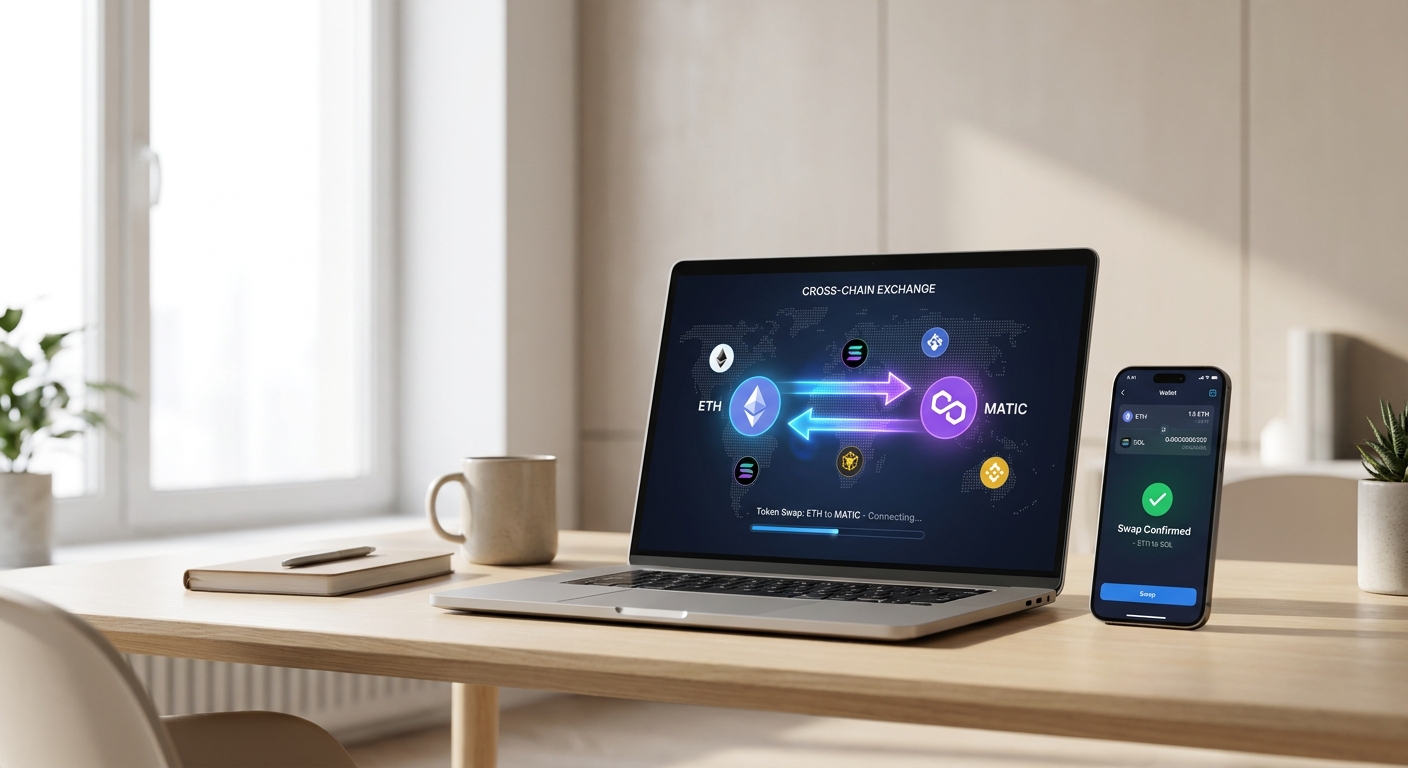
A cross-chain crypto swap is a transaction that exchanges one asset on one blockchain for another asset on a different blockchain, all without requiring a centralized intermediary to custody your funds. This article breaks down how cross-chain swaps work, why traders use them, the real risks you need to understand, and when you should use alternatives instead—bridges or centralized exchanges—depending on your specific needs.
Whether you’re rebalancing a portfolio across multiple chains, accessing liquidity unavailable on your current network, or simply looking to reduce trading fees, cross-chain swaps offer a non-custodial solution. But they come with execution risks that many articles gloss over. By the end of this guide, you’ll have a clear framework for choosing between swaps, bridges, and exchanges based on your actual use case.
What a Cross-Chain Crypto Swap Is
A cross-chain swap enables you to exchange tokens directly between blockchains—say, swapping Ethereum-based USDC for Bitcoin-backed USDC on Polygon, or trading ETH on Arbitrum for SOL on Solana. The process happens through interconnected protocols, smart contracts, and messaging systems that coordinate the exchange across two separate blockchain networks.
Unlike a simple same-chain swap on a single DEX, a cross-chain swap must solve the problem of atomic settlement: ensuring that both sides of the trade complete together, or neither completes at all. Without atomic guarantee, you could send your asset and never receive the destination token.
How the Swap Flow Works
The typical user journey is straightforward. You connect your wallet to a cross-chain swap interface, select your source asset and destination chain, approve the swap, and sign once. Behind the scenes, the protocol locks your token on the source chain, messages the destination chain network, verifies the message, and mints or transfers the destination asset to your wallet. Custody remains with the protocol’s smart contracts—not a centralized exchange—though this introduces its own technical risks.
The speed varies. Some swaps settle in seconds; others take minutes if they rely on slower message-passing validators or relayers. The entire flow is designed to feel seamless, but each step introduces potential failure points.
Cross-Chain Swap vs Bridge vs Atomic Swap
These three mechanisms are often conflated, but they serve different purposes and carry distinct risk profiles.
| Method | Custody model | Speed | Risk profile | Best use case |
|---|---|---|---|---|
| Cross-chain swap | Protocol smart contracts | 30 seconds to 5 minutes | Medium—contract and message-passing risk | Converting assets between chains without leaving custody |
| Bridge | Protocol smart contracts or validators | 5–20 minutes | Medium to high—validator set, wrapper risk | Moving native assets to a destination chain |
| Atomic swap | Cryptographic hash-lock (peer-to-peer) | Variable—depends on peer coordination | Low—trustless, but coordination overhead | Direct peer trades with strong cryptographic guarantees |
Atomic swaps are the most trustless—they use cryptographic time-locks so neither party can cheat—but they require finding a willing peer and manual coordination, making them impractical for retail traders. Bridges move assets natively but introduce validator and wrapped-token risks. Cross-chain swaps offer a middle ground: non-custodial, automated, and liquidity-rich, but dependent on protocol and message-passing integrity.
Why Users Use Cross-Chain Swaps
Traders and DeFi users turn to cross-chain swaps to solve real problems: accessing yield on different chains, arbitraging price differences, rebalancing portfolios without expensive same-chain hops, and reducing fees by finding the cheapest liquidity across networks.
Cross-chain swaps are especially useful when the asset or liquidity you need exists on a different chain, and bridging first (then swapping) would be slower or more expensive than a direct swap. They also appeal to users who want to remain self-custodial and avoid centralizing assets on an exchange.
Core Benefits at a Glance
| Benefit | What it means | Why it matters |
|---|---|---|
| Interoperability | Access assets and apps across multiple blockchains from one wallet | Reduces friction of managing separate wallets per chain |
| Self-custody | You retain control of private keys; no exchange holds your funds | Removes counterparty risk from centralized intermediaries |
| Lower fees | Route through cheaper liquidity sources than same-chain options | Saves 10–50% on large portfolio moves |
| Liquidity diversity | Tap into deep pools on multiple chains without leaving your wallet | Reduces slippage and price impact on big trades |
| Speed | Fastest atomic settlement compared to bridging + swapping separately | Complete transactions in minutes, not hours |
| Direct conversion | Swap directly to your target asset on your target chain in one step | Avoids intermediate hops and token wrapping |
Main Risks and Failure Points
Cross-chain swaps are powerful, but they can fail in ways that cost you money or lock your assets. The risks range from technical vulnerabilities in smart contracts to user errors like approving unlimited token access or sending assets to the wrong network.
| Risk category | What can go wrong | User impact | Typical warning sign |
|---|---|---|---|
| Smart contract bugs | Unaudited or vulnerable code in swap or bridge contract | Funds frozen, stolen, or lost permanently | Contract address not verified or audit report missing |
| Message-passing failure | Relayers or validators don’t deliver cross-chain message | Destination asset never arrives; source asset locked | Transaction stalls after 10+ minutes with no status update |
| Wrapped-asset depegging | Bridged token loses backing or liquidity on destination chain | Swapped asset becomes worthless or illiquid | Sudden price drop or extreme slippage on swap interface |
| Validator or relayer compromise | Malicious operator approves fraudulent transactions | Wrong user receives tokens; assets diverted | Validator set changes unexpectedly or relayer goes offline |
| Wrong network approval | User signs transaction on wrong blockchain | Tokens sent to wrong address or burned | Transaction succeeds but tokens appear on unintended chain |
| Slippage and thin liquidity | Route has insufficient depth for your trade size | You receive fewer tokens than expected | Quote changes significantly between approval and execution |
| Phishing and signature abuse | Attacker tricks user into approving malicious contract | Unlimited token access granted to attacker | Approval request from unfamiliar address or interface |
| Bridge failure mid-route | Bridge component of swap route goes down | Partial execution; tokens stuck on one chain | Half your swap completes, then status hangs indefinitely |
Technical and Protocol Risks
Smart contract vulnerabilities are the highest-severity risk. A bug in the swap contract, bridge contract, or message-passing handler can cause total loss of funds with no recovery path. Even audited contracts can contain edge-case exploits, especially in nascent cross-chain protocols where the design space is still being explored.
Relayer and validator compromise represents another critical failure mode. If the network that carries messages between chains is controlled by a small set of operators, and one or more of those operators are hacked or turn malicious, they can approve fraudulent transactions, redirecting your assets. Validator set concentration is common in younger cross-chain networks.
Wrapped-asset backing is a persistent issue. When you swap to a token that was bridged and wrapped on the destination chain, you’re now holding a representation of the original asset. If the bridge is compromised or the original asset is no longer fully backed, your wrapped token can lose value or become unmoveable. Historical bridge hacks (Ronin, Poly Network, Wormhole) have cost users billions when wrapped tokens became worthless.
Market, Liquidity, and UX Risks
Even if the protocol is technically sound, market conditions and user mistakes can derail your swap. Here are the most common execution pitfalls:
- Slippage and price impact: Your swap route may have insufficient liquidity at your intended price. The larger your order, the worse your execution price becomes. Always check the slippage tolerance before signing.
- Thin or stale routes: Some cross-chain pairs have minimal liquidity. If you trade a low-volume token pair, you may experience 10–20% slippage even on small amounts.
- Network congestion delays: If the source or destination chain is congested, your message delivery slows. Meanwhile, the price of your target asset may move against you.
- Wrong-chain mistakes: It’s easy to accidentally approve a token on Ethereum while intending to swap on Polygon. Once signed, the transaction proceeds on the wrong chain and your tokens are stuck or sent to an unintended address.
- Unlimited approval abuse: Many swap interfaces request approval for unlimited token transfers. If the interface or contract is compromised, an attacker can drain your wallet of that token type across all transactions.
- Phishing and fake interfaces: Attackers create clones of popular swap sites. Signing a transaction on a phishing site grants the attacker permission to move your tokens.
How to Evaluate Safety Before Using One
Before you execute a cross-chain swap, run through a simple pre-execution checklist. This five-minute diligence can prevent most catastrophic losses.
- Verify the contract audit: Check the swap or bridge contract address on Etherscan, Solscan, or the equivalent block explorer for your source chain. Confirm that a reputable firm (Trail of Bits, ConsenSys Diligence, OpenZeppelin) audited the contract. Read the audit report summary for any flagged issues.
- Check the liquidity depth: Visit the swap interface and test a small order size first. If you’re planning a $10,000 swap, try a $100 swap and observe the slippage. If slippage is high even on a micro order, liquidity is thin and your full order will suffer worse execution.
- Inspect the route transparency: The swap interface should show you the exact path: which DEXs or bridges are being used, which tokens are intermediate steps, and what fees are charged at each step. If the interface hides the route, use a different service.
- Approve only what you need: Instead of unlimited approval, request approval for only the amount you intend to swap. Most modern swap interfaces allow you to customize the approval amount.
- Double-check the destination chain and address: Before you sign, confirm that the wallet address displayed is your correct address, and that the destination chain in the UI matches your intention. One character wrong, and your funds go somewhere unrecoverable.
- Verify the interface URL and SSL certificate: Confirm that your browser shows a green lock icon and that the URL matches the official site (e.g., official-swap.protocol.io, not officialsawp.io). Bookmark official sites to avoid typing the URL manually.
Practical Safety Checklist
Before signing any cross-chain swap, verify that the route uses audited contracts on both source and destination chains. Check the fee breakdown and confirm that your approval is denominated in exact tokens (e.g., “Approve 1000 USDC to SpenderAddress”), not unlimited or wildly higher than your order. Test the swap with a small amount first—even $50—to confirm the route works, then execute your full order once you’ve validated the speed and slippage.
Bridge vs Swap vs CEX: Which Alternative Fits Which Need
Cross-chain swaps are not always the best choice. Sometimes a bridge, a centralized exchange, or even a same-chain swap followed by a later bridge makes more economic or security sense. The following comparison will help you choose.
| Option | Custody | Speed | Fees | Security trade-off | Best for |
|---|---|---|---|---|---|
| Cross-chain swap | Non-custodial (protocol) | 30 sec–5 min | 0.1–0.5% + gas | Contract and message-passing risk | Converting assets between chains while retaining self-custody |
| Bridge | Non-custodial (protocol) | 5–20 min | 0.01–0.3% + gas | Validator and wrapped-asset risk | Moving native assets to a destination chain |
| Centralized exchange | Custodial | Instant–2 min | 0.1–0.5% | Exchange counterparty and regulatory risk | Simplicity, deep liquidity, fiat on/off-ramps |
| Same-chain swap | Non-custodial (DEX) | 10–30 sec | 0.01–0.3% + gas | DEX contract risk (lower than bridges) | Converting assets on a single chain before bridging manually |
When a Bridge Is Better
Use a bridge when your goal is to move a native asset or its canonical representation to another chain for long-term holding or use. If you want ETH on Arbitrum and plan to use it for yield farming or lending there, bridging is cleaner than swapping, because you’ll own the true native asset (or its most-trusted wrapped version) rather than a swap-routed surrogate.
Bridges are also better when you prioritize transaction finality. A bridge confirms your asset transfer on the destination chain more transparently. A swap route that includes a bridge component adds an extra failure point—if the bridge segment fails, the entire swap fails, and you’re left with custody ambiguity.
When a Centralized Exchange Is Better
If you’re a beginner and prioritize simplicity above all, a CEX like Kraken, Coinbase, or Bybit lets you deposit on one chain, trade across chains, and withdraw to another chain in a single interface, with strong customer support if something goes wrong.
CEXs also excel at volume. If you’re trading a large amount or an illiquid pair, a CEX’s deep liquidity often beats fragmenting across DEXs and bridges. You also gain access to fiat on and off-ramps: deposit USD, sell crypto, or buy crypto with minimal friction.
The trade-off is custody. You’re trusting the exchange with your private keys and compliance procedures. If the exchange is hacked, becomes insolvent, or restricts your account due to regulatory scrutiny, your funds are at risk. For long-term holdings or privacy-conscious users, this is unacceptable. For short-term traders, the convenience and liquidity often outweigh the custody risk.
Choosing the Right Swap Model by Use Case
Different users have different priorities. A casual holder needs simplicity and safety. A DeFi power user needs best execution and lowest fees. A privacy-focused trader needs non-custody and anonymity. Use the following framework to pick the right tool.
Use-Case-Based Recommendations
| Use case | Best option | Why | Main caution |
|---|---|---|---|
| Beginner, under $500 | Centralized exchange | Simplest onboarding, best customer support, no signature complexity | Account restrictions or KYC delays |
| Active trader, $1k–$10k | Cross-chain swap (top 3 protocols) | Good liquidity, faster than bridge, self-custody maintained | Execution risk if route is thin |
| Large portfolio rebalancing, $50k+ | Split between bridge and swap | Bridge for core holdings, swap for tactical rotations | Complexity; requires tracking multiple transactions |
| Privacy priority | Non-custodial swap on Monero-compatible chain or atomic swap | Maintains anonymity, no CEX KYC | Thin liquidity, slow execution, user coordination overhead |
| Yield farming on new chain | Bridge native asset, then swap for yield token on-chain | Ensures asset integrity, avoids wrapped-token risk mid-route | Two transactions instead of one; higher total gas cost |
What Strong Competitor Articles Cover Well
Top-ranking articles on cross-chain swaps typically open with a clear, one-sentence definition and emphasize speed and non-custodial appeal immediately. They then list benefits—lower fees, interoperability, self-custody—before diving into risks.
Most comprehensive pieces include a risks section, though many abstract technical risks into broad categories like “smart contract risk” without explaining user impact. The better articles add a comparison table (swap vs bridge vs CEX) and a short platform list.
Common Coverage Patterns
| Competitor angle | Coverage depth | SEO value | Gap to exploit |
|---|---|---|---|
| Definition + benefits first | Shallow; 500–800 words | High initial ranking; high bounce rate | Deepen with execution risk and failure case examples |
| Risk section as afterthought | Surface-level language; no user-impact mapping | Low; readers distrust the piece | Lead with risks translated into real losses; explain failure modes |
| Comparison table (swap vs bridge) | Present but minimal rows/columns | Medium; satisfies search intent | Expand with detailed trade-off rows (speed, fees, risk profile) |
| Platform reviews | Lists 5–10 protocols, often with affiliate links | Medium—traffic, low trust | Neutral comparison framework without promotion |
Unique Angles to Add
- Failure-mode case studies: Describe what happens when a bridge component fails mid-swap, including actual examples from 2023–2025 where users lost funds.
- Decision trees and checklists: Provide step-by-step logic that tells readers exactly which option to use based on their amount, asset, and priority.
- Wrapped-token risk deep-dive: Explain pegging mechanisms, how wrapping breaks down, and how to identify which tokens are safe.
- Relayer and validator concentration analysis: Show which cross-chain networks have concentrated validator sets and why that matters for security.
- Slippage quantification: Test actual swaps on major platforms and show expected slippage for different order sizes, so readers have concrete expectations.
Conclusion and Decision Framework
Cross-chain swaps solve a real problem—they let you move value between blockchains without centralized intermediaries, often faster and cheaper than alternatives. But they’re not a universal solution.
Use a cross-chain swap when you want to convert one asset to another across blockchains while retaining non-custodial control and you’re confident in the protocol’s audit status and route liquidity. Use a bridge when you want native assets on a destination chain and can tolerate longer settlement times. Use a centralized exchange when simplicity, deep liquidity, and customer support matter more than self-custody.
The decision comes down to your priority: convenience, security, fees, or speed. Map your use case to the framework in this article, run the pre-swap checklist, and you’ll avoid the vast majority of cross-chain swap failures.
Simple Final Rule
If you need to convert assets between chains and you’re comfortable with non-custodial protocols, use a cross-chain swap on an audited platform with proven liquidity. If you need native assets or prefer simplicity, bridge or use a CEX instead.